Embark on an exciting journey into K’nex roller coaster construction. This guide provides comprehensive instructions for designing, building, and refining your thrilling creations. Learn essential engineering principles to bring imaginative coaster visions to life, ensuring optimal performance and endless fun.
Why Build a K’nex Roller Coaster?
Building a K’nex coaster offers a uniquely engaging and educational experience. It’s an exceptional way to explore fundamental principles of physics and engineering in a hands-on environment. Enthusiasts gain practical insight into concepts such as gravity, kinetic, and potential energy as they design intricate track layouts and thrilling drops. This creative endeavor fosters problem-solving, encouraging builders to troubleshoot flaws and optimize performance. The process enhances spatial reasoning and fine motor dexterity, making it a valuable learning tool for all ages. Beyond the academic benefits, constructing a working K’nex coaster provides immense satisfaction and a sense of accomplishment. It’s a fantastic outlet for creativity, allowing builders to imagine and execute complex structures, loops, and inversions. The reusability of K’nex components means endless possibilities for reconstruction and improvement, ensuring sustained engagement; This activity transforms abstract scientific ideas into tangible, exciting creations, making learning fun and memorable. It’s more than a toy; it’s a dynamic platform for innovation and discovery, perfect for developing critical thinking while having fun.
Overview of K’nex Coaster Kits
K’nex offers a diverse range of roller coaster kits, expertly catering to builders of all skill levels, from novices to experienced engineers. Each kit typically includes a comprehensive assortment of K’nex rods, connectors, specialized track pieces, and often a motor essential for lift hills. Instructions usually guide users through specific designs, though the true enjoyment lies in customization and creating original structures. Beginner kits feature simpler layouts, focusing on foundational mechanics and structural stability. More advanced kits, like the Thrill Rides series, introduce complex elements such as exhilarating loops, challenging inversions, and sophisticated multi-track systems, demanding intricate structural planning. Some kits even incorporate digital components or integrate with mobile apps for enhanced design possibilities. The inherent beauty of these kits is their remarkable modularity, allowing parts from various sets to be combined, significantly expanding the potential for colossal and unique coaster designs. While today’s internet data focuses on infrastructure and software, K’nex kits’ core appeal remains transforming abstract engineering concepts into tangible, thrilling models, fostering creativity and problem-solving through engaging, hands-on construction.
Gathering Your K’nex Components
To begin your K’nex roller coaster project, first organize all necessary parts. This crucial step involves identifying the correct rods, connectors, and specialized track pieces. A well-sorted collection ensures a smooth, efficient building process, allowing you to focus on design and engineering precision.
Identifying Essential Rods and Connectors
Building a K’nex roller coaster hinges on identifying essential rods and connectors. Rods, color-coded by length, form the structural skeleton. Green rods are shortest, followed by white, blue, yellow, red, and the longest grey. Knowing these lengths is vital for stability and precise dimensioning. Connectors dictate angles and junctions, effectively linking the rods together. These multi-directional pieces vary from simple one-way clips to eight-way hubs, each serving specific connection needs. Two-way connectors create straight extensions, while four or five-way types enable intricate turns and robust bracing. Before assembly, meticulously sort all your K’nex pieces. Organize rods by color/length and connectors by their connection points. This systematic approach ensures quick access to components for every coaster phase, from foundation to track. Proper identification and organization are foundational for a robust, high-performing K’nex roller coaster.
Understanding Specialty K’nex Pieces
Building a K’nex roller coaster involves more than just basic rods and connectors; understanding specialty pieces is crucial for advanced designs and functionality. Key among these are the various types of K’nex motors, which are indispensable for creating operational lift hills, propelling cars to the initial height to harness potential energy effectively. These robust motors often integrate seamlessly with gears and chain links, forming the precise mechanical system that consistently pulls the coaster car up its initial incline.
Another vital specialty component is the K’nex coaster car itself, typically featuring wheels meticulously designed to smoothly navigate the K’nex track system without excessive friction. Specialized track clips and dedicated supports are also engineered to securely hold track sections firmly in place, preventing frustrating derailments and ensuring overall structural integrity, especially on steep drops or challenging inversions. Furthermore, flexible tubing or specialized bendable rods allow for unique, sweeping curves and tight helixes that standard rigid rods cannot achieve. A thorough awareness of these components’ specific roles and how they interact elevates a simple K’nex structure into a truly dynamic, functional roller coaster experience, optimizing performance and enabling complex elements.
Selecting the Right Track Elements
Choosing appropriate K’nex track elements is fundamental for a successful roller coaster, directly influencing its flow, speed, and complexity. Standard straight track sections are essential for establishing initial velocity, long drops, and braking zones, ensuring a smooth, linear progression. For dynamic turns and directional changes, K’nex provides curved track pieces in various radii. Smaller radius curves create tighter, more intense turns, requiring careful consideration of speed to prevent derailment, while larger curves allow for graceful sweeping motions. Flexible track tubing is invaluable for crafting custom shapes, including intricate loops, corkscrews, and helixes, offering unparalleled design freedom for inversions and unique features. The specialized track pieces designed for the lift hill mechanism, often featuring teeth or grooves, are crucial for engaging the chain system and smoothly transporting the coaster car to its peak height. When selecting track, consider the desired speed profile and gravitational forces at play. Proper selection ensures seamless transitions between different sections, maintains momentum, and supports the overall structural integrity. Each track type serves a specific purpose, contributing to the exhilarating experience of a well-engineered K’nex coaster.
Core Principles of K’nex Coaster Engineering
Mastering K’nex coaster engineering involves fundamental physics. Focus on harnessing gravity for speed, managing kinetic energy through the layout, and minimizing friction for smooth operation. These principles ensure your designs are both thrilling and functional, providing a solid foundation.
Harnessing Gravity and Potential Energy
The fundamental principle behind any K’nex roller coaster operation involves the precise conversion of potential energy into kinetic energy, driven solely by gravity. To effectively harness these powerful forces, your coaster design must always begin with significant elevation. The lift hill raises the coaster car to its highest point, maximizing its gravitational potential energy. This stored energy is absolutely crucial, converting into kinetic energy to propel the car through the track layout, including thrilling inversions. Consider the initial drop: a steeper and higher drop results in greater acceleration and speed due to the rapid conversion of potential energy. This initial burst of speed is vital for overcoming track friction and maintaining necessary momentum throughout the ride. As the car descends, gravity continuously pulls it downwards, converting accumulated height into swift velocity. Strategic use of varying heights and slopes ensures the coaster maintains sufficient energy to complete its entire journey without stalling. Understanding this critical energy transformation is truly key to designing a successful K’nex roller coaster.
Managing Kinetic Energy and Momentum
Effectively managing kinetic energy and momentum is paramount for a smooth and successful K’nex roller coaster. Once the potential energy from the lift hill is converted into kinetic energy during the initial descent, the coaster car possesses the speed and force needed to navigate the entire track. Maintaining adequate kinetic energy is crucial to overcome upward inclines and successfully complete inversions like loops. If the car loses too much speed due to friction or improperly designed track elements, it will stall. Similarly, momentum, which is the product of mass and velocity, ensures the car carries through sections where gravity isn’t directly assisting propulsion. Proper track banking on curves helps redirect the car’s momentum, preventing derailment and ensuring a controlled path. Designers must carefully balance speed; too much kinetic energy can cause the car to fly off the track on sharp turns, while too little will prevent it from finishing complex maneuvers. Precision in track angles and transitions optimizes the transfer and conservation of these vital forces.
Minimizing Friction for Optimal Performance
Minimizing friction is paramount for optimal K’nex roller coaster performance. Unwanted friction, primarily between the coaster car’s wheels and the track, significantly reduces its kinetic energy. This energy loss directly impacts the coaster’s ability to complete its intended path, particularly through loops, inversions, and uphill sections. Builders must pay close attention to the alignment of track pieces, ensuring they are smooth and free of snags or sharp angles that could impede the car’s flow. Regularly cleaning the track and wheels can also help reduce resistance from dust or debris. Lubricating axles or connection points, if appropriate for the K’nex material, can further enhance performance, allowing the car to glide more freely. This meticulous approach to reducing resistive forces ensures the coaster car maintains sufficient speed and momentum, leading to a thrilling and uninterrupted ride experience from start to finish. Without careful attention to friction, even the best-designed layouts will falter, making this a cornerstone of K’nex coaster engineering for reliable operation and sustained exhilaration.

Constructing the Foundation and Support
A sturdy K’nex coaster needs a strong foundation. Build a wide, stable base with robust rods and connectors. This prevents swaying, providing critical support for the entire structure. Ensure firmness for thrilling, reliable operation.
Building a Stable Base Structure
A truly stable base structure is the absolute cornerstone of any successful K’nex engineering endeavor. Without a strong foundation, the entire project risks instability, swaying, or even collapse, especially as dynamic forces from moving elements come into play. Begin by laying out a broad, wide footprint using the longest and most robust available K’nex rods. This maximizes ground contact area, significantly improving stability. Utilize many multi-directional connectors to create a dense, rigid grid pattern at the lowest level. Triangular bracing is highly recommended; incorporating diagonal supports within frames adds immense rigidity, preventing lateral movement. Ensure all connections are pushed firmly, eliminating looseness. Consider building the base in multiple layers, stacking and interlocking for enhanced strength and weight distribution. The base must be significantly wider than the highest point of your design to prevent tipping. This robust, unyielding platform will serve as the reliable anchor, providing essential support for subsequent vertical towers and intricate track layouts. Investing meticulous time here guarantees a secure and enjoyable building experience, preventing frustrating failures later on.
Designing Vertical Support Towers
Vertical support towers are absolutely crucial for achieving the desired height and structural integrity of your K’nex roller coaster. After establishing a robust base, the next step involves strategically erecting these pillars to elevate the track to its intended elevation. When designing, prioritize comprehensive triangulation; connecting rods diagonally across rectangular frames vastly increases stability against lateral forces, effectively preventing unwanted sway. Use longer rods for significant height and ensure each tower is firmly connected to the base structure, often with strong multi-pronged connectors. Distribute towers evenly beneath the track, especially at points of significant stress like the peak of a lift hill or just before a steep drop. For taller sections, consider building wider towers at the bottom, tapering slightly as they rise, to enhance their resistance to toppling. Reinforce all connections at every junction to minimize any potential flex. The design must anticipate the dynamic loads from the coaster car, ensuring the towers can withstand both vertical compression and any horizontal forces exerted during turns or inversions. Proper vertical support is paramount for a smooth, safe, and exciting ride experience.
Creating the Lift Hill Mechanism
The lift hill mechanism is vital for elevating the coaster car to its initial height. This section will guide you through constructing the system that harnesses potential energy. A reliable lift ensures a successful and thrilling start to your K’nex adventure.
Assembling the Lift Hill Track Section
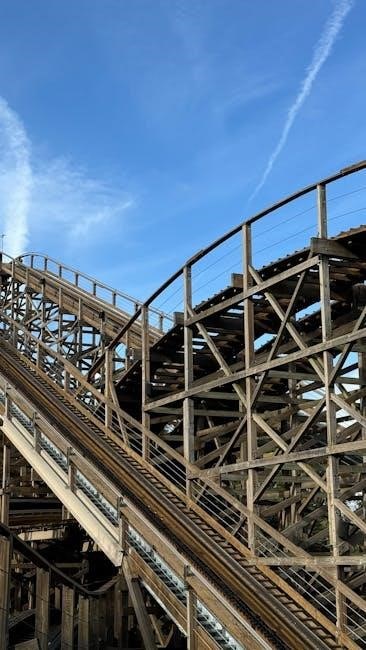
Assembling the lift hill track section demands precise construction for a smooth, reliable ascent. Begin by building a strong, inclined support structure using essential K’nex rods and connectors. The chosen angle of incline significantly impacts performance; a moderate slope balances power requirements with a thrilling initial climb. Securely fasten individual track pieces onto this framework, ensuring perfect alignment to prevent snags or derailments. Each track segment must connect seamlessly, creating a continuous path. Integrate robust vertical supports along the entire lift hill to withstand the coaster car’s weight and the future chain system’s forces. Utilize longer, more stable rods for all taller sections. The apex of the lift hill needs a meticulously crafted, smooth transition into the subsequent track, positioning the car for its exhilarating descent. This precise assembly establishes the fundamental pathway for crucial potential energy.
Integrating the Motor and Chain System
Integrating the motor and chain system is pivotal for a functional K’nex roller coaster lift hill. Securely mount the K’nex motor near the base of your lift hill, ensuring it’s stable and aligned to drive the chain efficiently. Connect the motor to a series of K’nex gears, carefully selected for the desired speed and torque to pull the coaster car up the incline. A smaller gear on the motor driving a larger gear connected to the chain sprocket will provide more pulling power. Assemble the K’nex chain links, ensuring they are robustly connected to form a continuous loop that runs the entire length of the lift hill. The chain should be guided by sprockets or smooth rollers at both the top and bottom of the incline to maintain tension and prevent slippage. Attach small “lift hill dogs” or claw pieces to the underside of your coaster car, designed to engage with the chain links. Test the system thoroughly to ensure the chain moves smoothly without snagging and the car consistently latches on and releases at the top. This synchronized mechanism transforms electrical energy into the potential energy required for the ride.
Designing and Building the Track Layout
Designing your K’nex roller coaster track demands careful planning. Envision ascents, descents, and thrill elements. This section guides forming straight sections, crafting curves, and constructing exciting loops and inversions for an exhilarating experience.
Forming Straight Track Sections
Creating robust and perfectly aligned straight track sections is fundamental to any K’nex roller coaster’s success. Begin by establishing a solid, level foundation using a grid of K’nex rods and connectors. This base prevents sagging and ensures stability for the track above. For the track itself, utilize the longer K’nex rods, such as green, white, or yellow, depending on the desired length and structural integrity. Connect these rods using appropriate connectors, focusing on creating a rigid, rectangular framework that will support the track pieces.
Carefully snap the specialized K’nex track pieces onto this framework. Precision is paramount here; even minor misalignments can lead to friction or, worse, derailments. Double-check that each track piece is securely fastened and forms a smooth, continuous path. For extended straight sections, incorporate additional vertical and diagonal bracing to prevent flexing or wobbling, which could compromise the coaster’s flow. Remember that a well-constructed straight section provides the necessary speed and stability before entering more dynamic elements, making meticulous assembly critical for optimal performance and thrill. Consistent testing with your coaster car throughout this process will reveal any imperfections requiring adjustment.
Crafting Curves and Turns
Crafting effective curves and turns is essential for adding dynamic flow and excitement to your K’nex roller coaster. Unlike straight sections, curves introduce centripetal force, which must be managed for a smooth ride. Begin by planning the radius of your turn; tighter turns require more structural support and careful banking. Utilize the specialized curved K’nex track pieces, connecting them securely to form the desired arc. For stability, these curved sections must be supported from underneath and to the sides with a robust framework of rods and connectors.
To prevent the coaster car from flying off the track during a turn, implement banking. This involves raising the outer edge of the track higher than the inner edge, counteracting the outward force. Experiment with different degrees of banking, using varying lengths of support rods to achieve the desired angle. Gentler curves might require minimal banking, while sharper turns will need a more pronounced tilt. As you build, continuously test the curve with your coaster car, observing its momentum and stability. Adjust supports and banking as needed to ensure the car navigates the turn effortlessly, maintaining speed and preventing derailments, which is key to a successful K’nex coaster.
Constructing Loops and Inversions
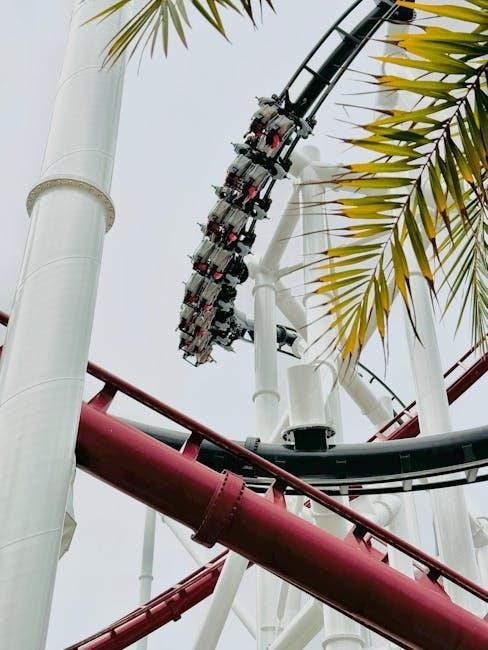
Constructing intricate loops and inversions represents a pinnacle of K’nex roller coaster engineering, demanding precise planning and robust execution. These gravity-defying elements are thrilling additions, but require careful consideration of kinetic energy and momentum to ensure the coaster car successfully navigates the inversion without falling. Begin by ensuring the car has sufficient speed and height gained from a preceding drop, as this potential energy converts into the kinetic energy needed to complete the loop. A common loop design often starts with a gradual ascent, transitioning into a circular or teardrop shape, and then a gradual descent back to the main track. The structural integrity of a loop is paramount; extensive support rods and connectors must be used to create a rigid framework around the entire inversion, preventing collapse or flexing. Reinforce key stress points, particularly at the entrance and exit of the loop, and throughout its apex. Like any complex engineering project, such as managing traffic flow on a major bridge, meticulous attention to detail during construction is vital. Regularly test the loop with your coaster car, making small adjustments to banking, support, and entry/exit angles until the car smoothly completes the inversion, which is critical for mastering these advanced K’nex features.
Testing, Troubleshooting, and Customization
Test, adjust, and refine your K’nex coaster for optimal performance. Identify common issues like stalls or derails, and implement solutions. Finally, personalize your creation with unique features, ensuring a thrilling and reliable ride every time.
Initial Testing and Adjusting Track Flow
Initial Testing and Adjusting Track Flow is a critical step in K’nex roller coaster construction. Once your track layout is complete, the first test run reveals about its functionality. Begin by manually guiding a coaster car through the entire course. Observe closely for any points where the car slows, sticks, or derails. These initial observations are vital for identifying areas needing immediate attention and adjustment.
Focus on how gravity and kinetic energy are managed throughout the system. A smooth, uninterrupted flow is the primary indicator of a well-engineered track. If the car struggles on an incline, the lift hill’s power or the preceding drop’s height might need modification. For sharp turns, inadequate banking can cause the car to lose momentum or even fly off. Reinforce any wobbly supports to ensure structural integrity during high-speed sections.
This iterative process of testing, observing, and adjusting is fundamental. Minor tweaks, such as slightly altering track angles, reinforcing weak points, or refining connector alignment, can dramatically improve performance. Continue running tests until the coaster car consistently navigates the entire track flawlessly, demonstrating consistent speed and stability.
Common Problems and Solutions
Encountering issues during your K’nex roller coaster build is common, but most have straightforward solutions. A frequent problem is the coaster car derailing, often due to insufficient banking on curves or flimsy track connections. To fix this, reinforce the track supports, ensure all connectors are securely snapped into place, and consider adding steeper banking to high-speed turns to counteract centrifugal force.
Another prevalent challenge is the car losing momentum and stalling, particularly after a loop or uphill section. This usually indicates insufficient potential energy from the initial drop or excessive friction. Increase the height of your starting point to provide more potential energy, and meticulously check all track segments for smooth alignment to minimize friction points. Ensure the lift hill motor and chain system are operating efficiently, providing consistent power to reach the peak.
Structural instability, manifesting as wobbly towers or collapsing sections, requires immediate attention. Strengthen your base structure and add more diagonal bracing to support towers, distributing weight evenly. Lastly, check for any snags or misaligned pieces that might impede the car’s flow. Persistent testing and methodical adjustments are key to overcoming these hurdles and achieving a perfectly running coaster;
Adding Custom Features and Enhancements
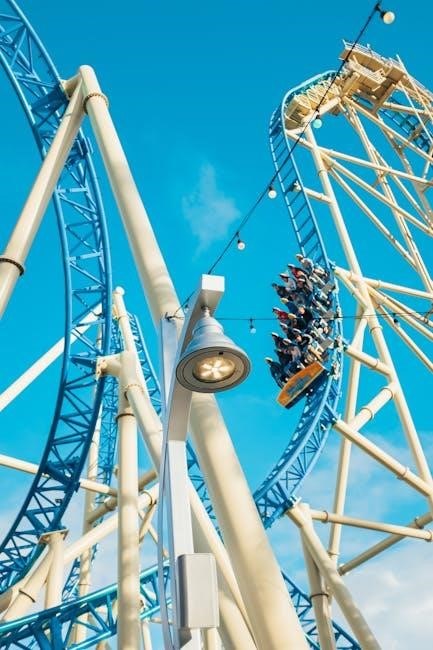
Beyond the fundamental structure, personalizing your K’nex roller coaster with custom features elevates the experience. Consider integrating decorative elements like miniature buildings, trees, or themed signage along the track, transforming your coaster into a unique landscape. For an interactive touch, you could design small, movable obstacles or dynamic track sections that change configuration during a ride. Experiment with advanced track elements such as helixes, corkscrews, or even multiple lift hills for increased complexity and thrill. Incorporating lighting, perhaps small LED strips along the track or spotlights on key features, can dramatically enhance the visual appeal, especially in dim lighting. Sound effects, triggered by the coaster car passing specific points, can add another layer of immersion. Don’t limit yourself to the standard K’nex pieces; explore ways to integrate other building toys or craft materials for truly unique aesthetics. Think about creating a loading station with intricate details or a themed exit area. These enhancements not only make your coaster more visually engaging but also provide additional engineering challenges and opportunities for creative expression, ensuring your K’nex creation stands out. The possibilities for customization are endless once the core track is stable and operational.